When Chinese Characters Repeat: A Visual Shortcut to New Words
Chinese characters are not random pictures, but they do reward you for looking closely. Sometimes a character is repeated two or three times to build a new character. The result is not simply “the same thing, multiplied,” but the repetition often gives you a useful visual clue about the new word.
That makes repeated characters a practical memory shortcut for beginners. You can spot a familiar building block, connect it to a simple image, and then learn the new character with its own pronunciation and meaning.
A useful rule of thumb: repetition is a visual memory hook, not a mathematical formula. It can suggest more quantity, more intensity, or a related idea—but every completed character has its own established sound and meaning.
The clearest family: tree, woods, forest
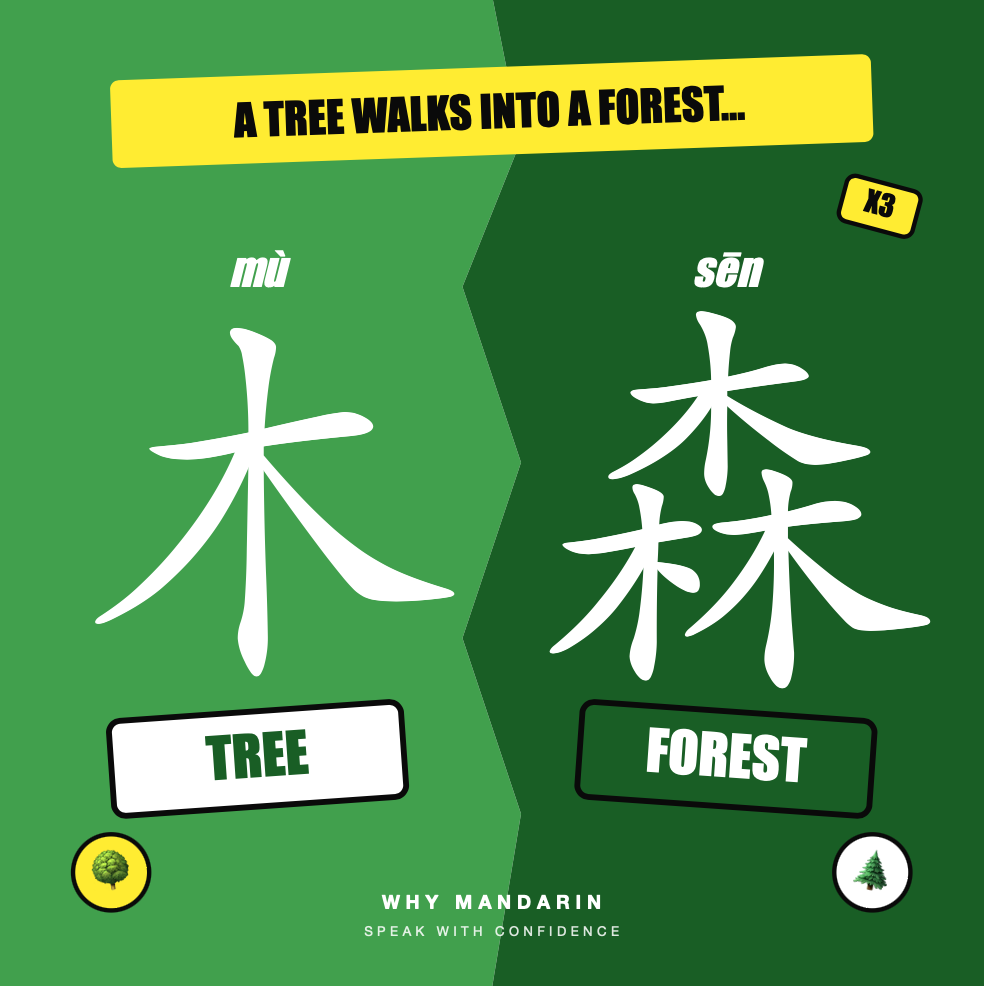
The 木 family is a perfect place to start. One tree becomes a small group of trees, then a forest. The visual connection is easy to hold in your mind, even before you know much vocabulary.
What happens when a character doubles?
Some double forms are wonderfully visual. 一 becomes 二: one horizontal line becomes two. 木 becomes 林: a tree becomes a grove. Other examples take a little more imagination, but the repeated shape still gives your eye a memorable starting point.
And when it triples?
Three copies can make the visual story even stronger. Three people look like a crowd, three trees suggest a forest, and three suns help you remember a character associated with brightness and crystal-like sparkle.
Cantonese Jyutping: jan4 → zung3
Cantonese Jyutping: hau2 → ban2
Cantonese Jyutping: jat6 → zing1
A pattern is a clue—not the whole definition
It is tempting to expect every repeated character to have an obvious “more of the same” meaning. Chinese is more interesting than that. 山 + 山 becomes 出, meaning “to go out” or “exit,” while 月 + 月 becomes 朋, meaning “friend.” These shapes are still helpful visual anchors, but the finished character must be learned as a complete word with its own pronunciation.
In Hong Kong, you may also see traditional forms. For example, the simplified 双 means “pair,” while the traditional character is 雙. The visual logic can support your memory in both writing systems, but it does not replace learning the word in context.
How to use this shortcut when you learn
First, spot the repeated building block. Next, make a quick visual story: two trees make a grove; three trees make a forest. Finally, say the complete character aloud and meet it in a real word or sentence. That last step matters, because the new character has a new sound as well as a new meaning.
This guide expands on Why Mandarin’s Repetitive Characters ×2 and Repetitive Characters ×3 posts. Save the examples that make sense to you, then look for the same visual building blocks in the characters you meet next.